The Science: Fact vs. Fiction
1. Scorpions Do Not Have "Nests" or "Colonies"
The Science: Unlike social insects (bees, wasps, and ants), scorpions are solitary, predatory arachnids. They do not build physical structures, nests, or hives, nor do they have a queen or a structured colony.
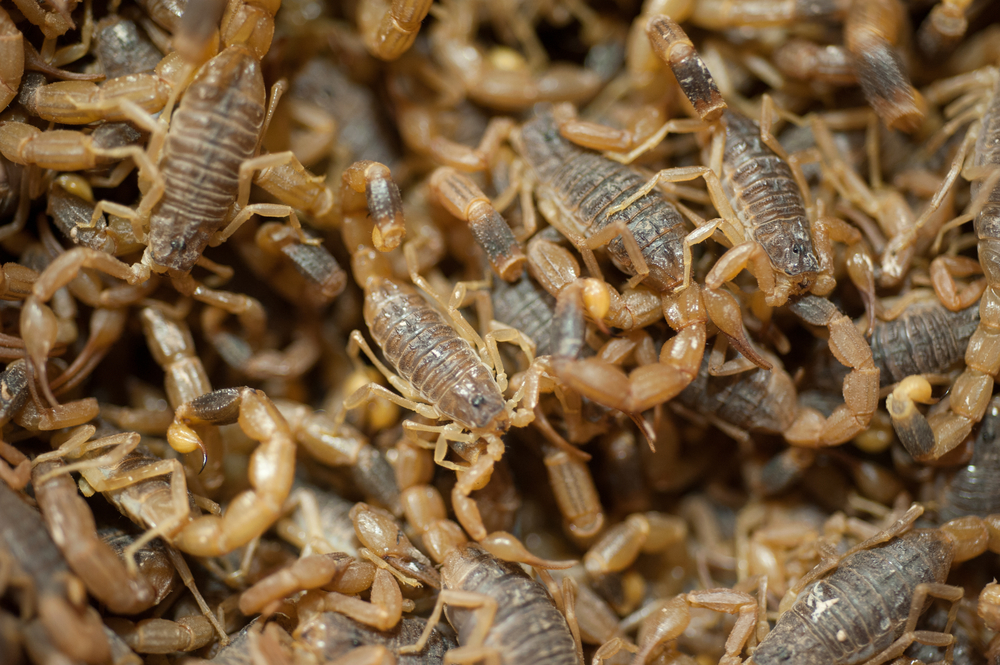
What Actually Happens: During the intense heat of the Las Vegas Desert summer or the cold Henderson winter, bark scorpions practice what is called winter aggregation or communal sheltering. They gather in tight, dark, humid crevices (like block wall crevices, under tree bark, under a potted plant, or in rock piles) simply to conserve moisture and survive the elements. It looks like a "nest" because you might find 20 to 30 scorpions stacked together, but they are not working together as a team.
A. Peak Nocturnal Activity
The Science: Shifting to a nocturnal schedule is a vital evolutionary strategy that allows them to minimize water loss and optimize prey capture when temperatures drop and humidity slightly rises. They generally emerge from their hiding spots shortly after sunset.
While bark scorpions possess a specialized, wax-like layer on their exoskeleton that makes them highly resistant to water loss, intense summer heat and prolonged dry spells still push them to their physiological limits.
B. They Do Not Jointly "Defend" Their Group
The Science: Social insects use alarm pheromones to trigger a coordinated mass attack if their hive is disturbed. Scorpions lack this social defense mechanism.
What Actually Happens: If you disturb an aggregation of bark scorpions, they will not swarm you like hornets. Instead, their primary instinct is to scatter and flee to find new cover. However, because they are tightly packed, disturbing them can cause them to scatter in all directions, including toward you or into your home—creating a chaotic situation that is much harder to control.
2. The Threat of the Arizona Bark Scorpion (Centruroides sculpturatus)
The Science: Bark scorpions are the most venomous scorpions in North America.
The Risk: While a single bark scorpion sting is rarely fatal to healthy adults due to modern medical care, their venom is neurotoxic and causes severe, radiating pain, numbness, and muscle twitching. Disturbing a large group increases the risk of sustaining multiple stings simultaneously, which significantly escalates the medical danger.
4. Why the "Wrong Product" Escalates Things Fast
The Science: Bark scorpions are highly resilient due to their thick exoskeleton. Using cheap, over-the-counter synthetic pyrethroids often fails to kill them immediately. Instead, it acts as an excitant.
The Reaction: The wrong chemical flushes them out of their hiding spots, makes them highly agitated, and drives them directly into living spaces. You now have irritable, venomous, still alive scorpions.
Scientific Polish Without The Fluff
Scorpion aggregations aren’t something you just spray and move on from. What looks like a simple hiding spot can actually be a cluster of the most venomous scorpions in North America: the bark scorpion. Unlike hornets or bees that actively defend a hive, a group of scorpions will scatter wildly when disturbed. Getting too close, using the wrong product, or agitating them just flushes them out in all directions—turning a hidden problem into an immediate home invasion. The goal isn't just to scatter them; it’s a detailed, targeted elimination of the entire group safely using advanced micro-encapsulated residuals. At Anderson Pest Control, we use a precise, science-based approach to eliminate these clusters safely. Leave the risk to the licensed experts. (702) 656-8898 | www.controlthebugs.com
Protect your home and family with an advanced, science-based approach—contact Anderson Pest Control today to schedule your Las Vegas Scorpion inspection.